




Diocese of Gaylord Pastoral Plan 2026
The Diocese of Gaylord announces the Pastoral Plan 2026 after more than a year of synodal listening; in-depth review of diocesan/parish data; collaboration amongst Bishop Walsh, the clergy, parish leaders and lay faithful across the diocese; and prayer. Implementation of the plan will begin July 2026.
This plan responds to real challenges—fewer priests, future projections, parish viability and stewardship of resources—while embracing a Gospel vision for vibrant parish life rooted in Love, Communion and Mission.
The plan includes parish changes, new clusters and updated priest assignments, as well as exciting initiatives for vocations, lay formation and youth/young adult ministry. Though change can be difficult, we trust in Divine Providence and believe this pruning will bear abundant fruit for generations to come in the fertile soil of Northern Michigan.
Special Message on July 1 Implementation Day
July 1, 2026, marks a historic moment for the Diocese of Gaylord. As we begin implementing Pastoral Plan 2026, Bishop Walsh shares a video message for every family across our diocese.
Together let us walk forward in hope.
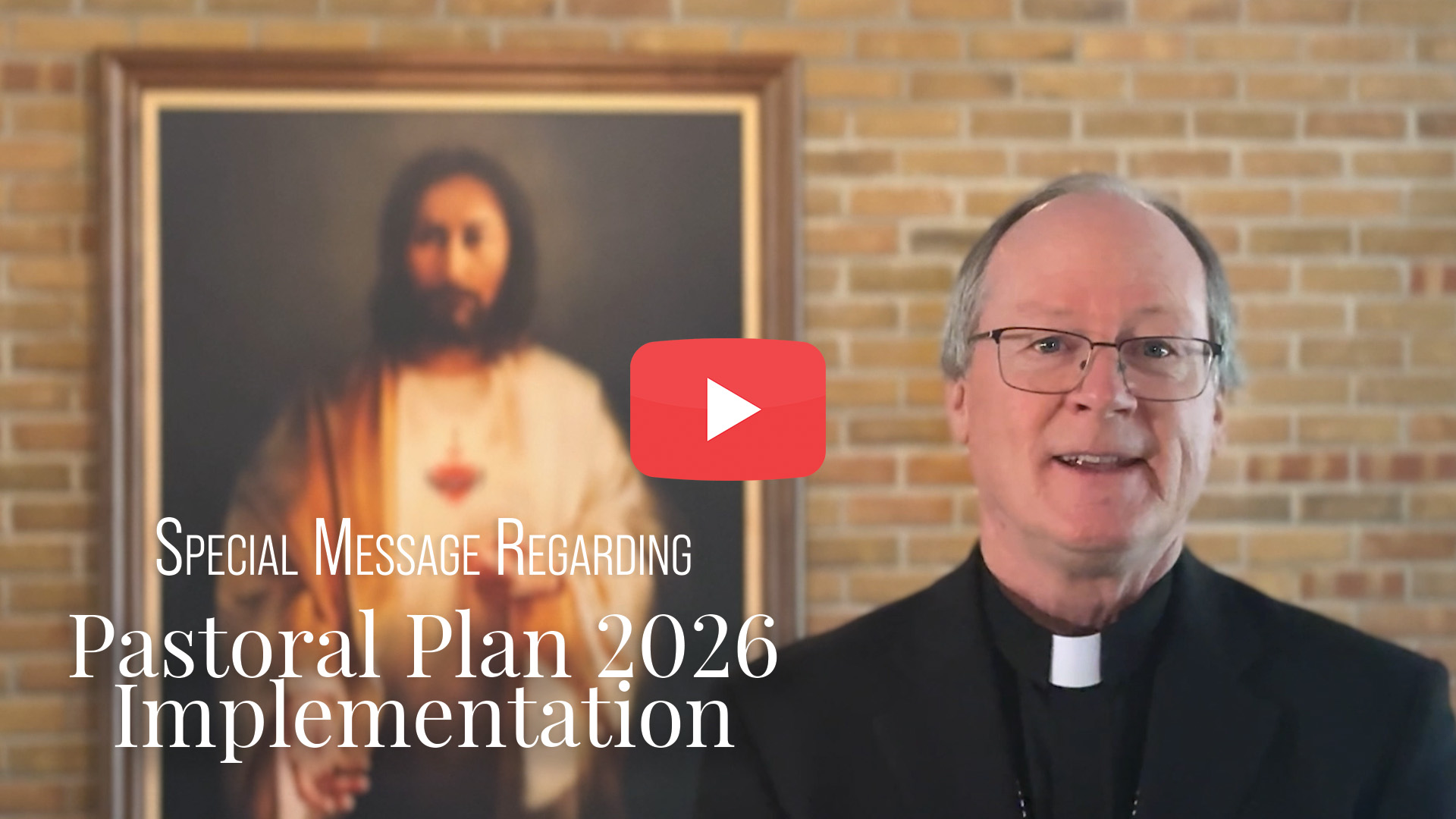
Bishop Jeffrey Walsh’s Decrees Related to Pastoral Plan 2026
In a spirit of transparency and pastoral care, Bishop Jeffrey Walsh has released 19 decrees related to Pastoral Plan 2026, outlining decisions regarding limited-use churches, parish closures and new territorial boundaries across the Diocese of Gaylord.
Click HERE to read the full decrees.
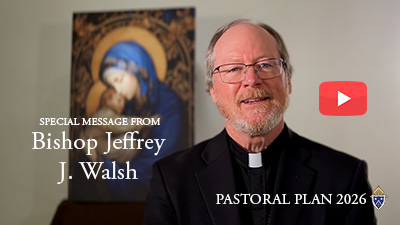
Special Message on January 21 Plan Release Day
Watch Bishop Walsh's video message and read his pastoral letter announcing Pastoral Plan 2026 and inviting us to walk forward in hope.
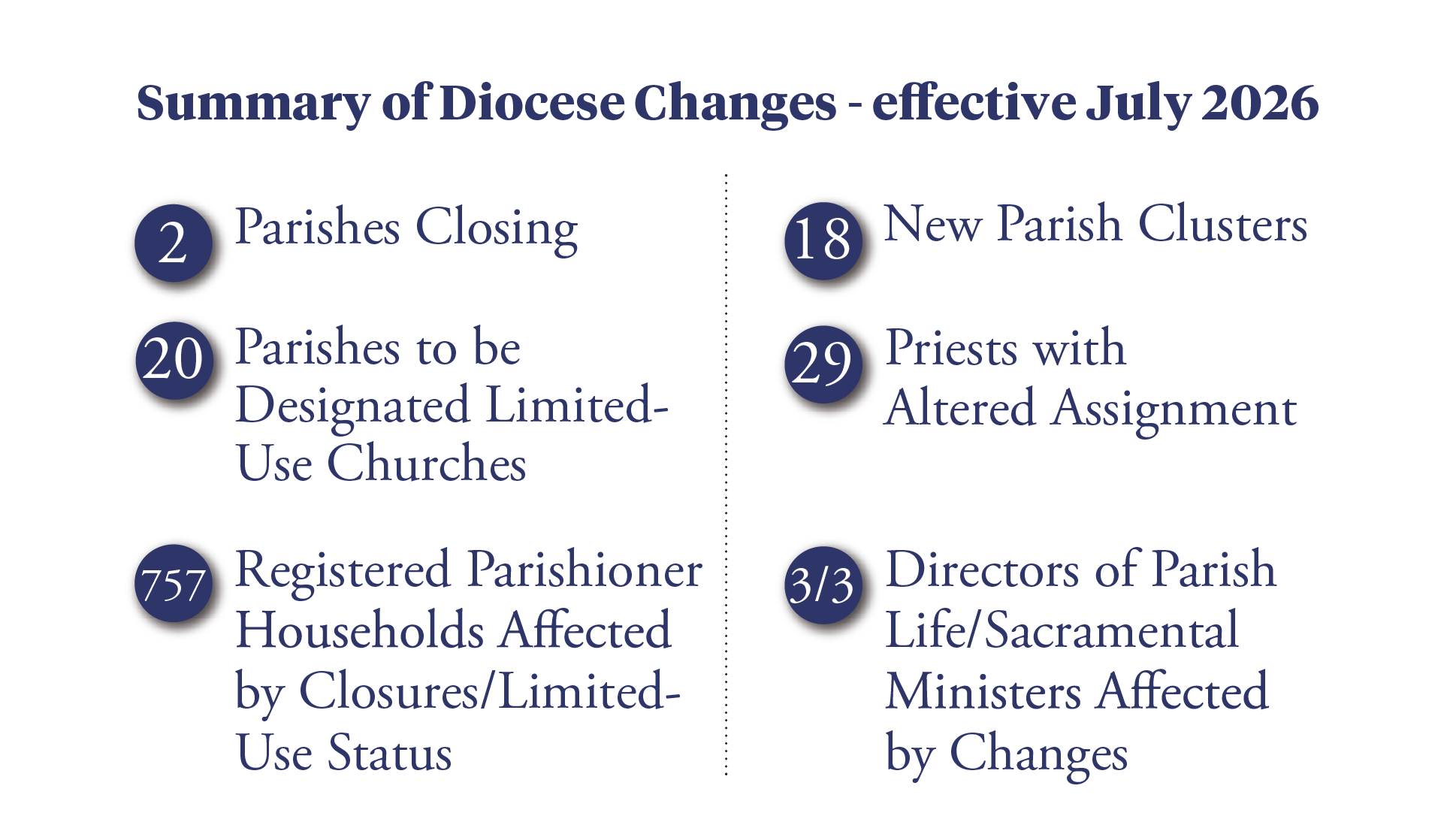
Changes at a Glance
Click on the Diocese of Gaylord data chart below to enlarge:
Image
|
Pastoral Plan 2026
The full diocesan Pastoral Plan 2026 includes:
- Introduction and guiding vision
- Summary of diocesan changes
- Vicariate-specific details (parish closures, limited-use churches, clusters, priest assignments)
- Future initiatives for vocations, lay formation and youth ministry
Questions & Answers
Find answers to common questions about parish changes, clustering, priest assignments and what this means for our diocesan family.
- Why did the diocese create a Pastoral Plan now?
Our diocese—and the Church across the U.S.—is experiencing real shifts: Mass attendance and sacramental practice have declined since the 1970s, and the number of priests has fallen by more than 40% nationwide. Many local churches are smaller, and most priests already serve multiple parishes. Pastoral planning helps us look honestly at these realities and prepare for a mission focused future.
- Did the bishop create the Pastoral Plan 2026 alone?
Bishop Walsh is responsible for the final plan, but it was formed through the synodal process; in-depth review of parish data; input from parish finance and pastoral councils, parish leaders, priests, deacons and directors of parish life; and of course, prayer. This has been a deliberate, collaborative process with input from hundreds of other sources—not rushed or done in isolation. The bishop has been quick to state: “This is not my plan; this is our plan.”
- When was the Pastoral Plan announced and when will implementation begin?
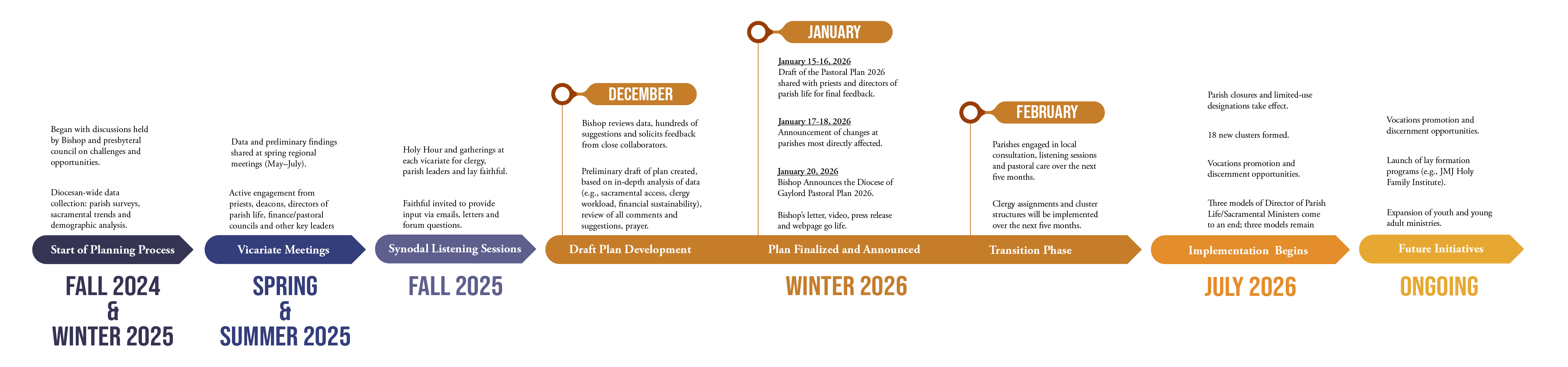
Bishop Walsh announced the Diocese of Gaylord’s Pastoral Plan 2026 on Jan. 20, 2026, with implementation beginning this July. The diocesan Pastoral Plan 2026 webpage outlines a timeline that moved from early data collection and spring vicariate meetings to drafting and consultation, culminating in a public announcement before implementation. Read the complete Pastoral Plan 2026.
- What kinds of changes are included in the Pastoral Plan?
The plan includes parish closures, parishes becoming limited-use churches, new parish clusters, revised vicariate boundaries and updated clergy assignments. These changes are being implemented to sustain sacramental life and strengthen the mission of the Church. Read the complete Pastoral Plan 2026.
At-a-glance diocese highlights:
– Starting July 2026, the diocese staff will include: 29 Pastors; 2 Priest Administrators; 10 Parochial Vicars; 29 Deacons; 8 Seminarians; 3 Directors of Parish Life, 3 Sacramental Ministers
– Total Catholic Schools: 16 (unchanged)
– Total Parishes in July 2026: 56
– Total Limited-Use Churches in July 2026: 20
- What is the difference between “parish” and “church”?
A parish is a portion of the people of God in a defined territory under the guidance of a pastor who is responsible for the care of their souls. A church is a physical structure which has been dedicated for divine worship.
- Why are closures or limited-use designations needed?
Rightsizing the Diocese of Gaylord helps ensure access to the sacraments throughout the diocese, creates reasonable workloads for priests, ensures financial stewardship and safeguards long term viability—criteria that helped guide the diocesan planning efforts.
- What does “limited-use church” mean?
“Limited use” means the church will not have regular weekend or weekday Masses. However, upon request and with the pastor’s discretion, weddings, baptisms, funerals and patronal Masses may still be celebrated there. There are some unique uses that will be decreed specifically for the Traditional Latin Mass at St. Thomas Aquinas in Elmira and seasonal liturgies for the peak summer months at St. Ignatius in Good Hart.
- Which parishes are closing or being designated limited-use churches?
In July, there are two parishes—St. Mary in Burt Lake and Jesus the Good Shepherd in Atlanta—that will close. There are 20 other parishes moving to limited-use churches.
- How were parishes selected for closure or limited use?
These decisions were complex, and there was no simple formula applied. It required an in-depth analysis of diocesan and parish data—like Mass attendance, finances, geography and projections—combined with the consultative feedback gathered through the vicariate synodal process along with prayer and a vision of faithful stewardship for the gift of the Catholic Church.
In the official canonical decree, which will serve as written notice of the change of status, more specific reasons will be stated for each parish being designated a limited-use church. The decrees are being worked on now; the diocese anticipates the decrees will be shared in March. When the decrees are finalized, a copy will be sent to each limited-use church to be posted and announced at Mass. The decrees will also be posted on the diocesan website.- Will limited-use churches still have councils and what happens to their finances?
Limited-use churches will be canonically merged into a receiving parish. The limited-use church will no longer have its own parish finance or pastoral councils. All revenue and expenses will be the responsibility of the receiving parish. There will be a distinct line item in the budget for the limited-use church to keep track of the expenses to maintain the physical building and property.
- What happens to parish registrations and sacramental records from a closed or limited-use church?
When parishes close or are designated limited use, registrations typically transfer to the receiving parish; however, each parishioner can ultimately decide the parish to which they wish to be registered. The sacramental records are preserved by diocesan and canon law norms. The receiving and closing parishes/limited-use churches will be provided with specific instructions.
- What about sacred art, memorials and cemeteries at closed/limited-use churches?
Diocesan offices of Worship and Archives/Chancellor oversee the reverent transfer or disposition of sacred items at parishes that are closing. In most cases, some sacred items from the closing parish will be transferred to the receiving parish.
No sacred items are moved from limited-use churches.
Cemeteries retain their dignity and oversight; the clustered parishes will continue to care for any cemeteries associated with a parish that is closing or designated limited use. Parish leaders should consult the Office of the Chancellor for parish specific guidance.- How are the parish clusters changing?
Today, some parish clusters group four or five parishes, which stretch clergy and make sustained presence difficult. Under the new plan, clusters are three or fewer parishes, with most clusters at two parishes. Additionally, many parishes will be entering a new parish cluster in July. These new clusters, along with updated clergy assignments, including support from parochial vicars, many of whom are international priests, are meant to balance workloads so priests can be more present to their people and parish life can flourish.
- How does the Pastoral Plan affect Mass times, ministries and schedules?
Within each parish cluster, pastors will coordinate Mass schedules so priests can serve effectively, and parishioners have access to the sacraments. Ministries will be encouraged to collaborate across cluster partners. Changes in schedules, especially for new clusters, will be communicated by the pastor as implementation nears.
- How will the diocese support those who are grieving?
Bishop Walsh acknowledges the sorrow many feel when a parish closes or changes. Parishioners can submit comments and questions through the online comment form. All submissions will be responded to and shared with Bishop Walsh. Many parishes are offering listening sessions, hospitality and pastoral care during the transition (now through the summer), and leaders are asked to welcome those who may join their communities. Reminder, we are never abandoned—new communities await.
- How does the plan connect to “Love, Communion and Mission”?
As we implement the plan, Bishop Walsh invites us to embrace the future with the credo: Love, Communion, Mission. Love in conversation and action, Eucharistic communion with Christ and each other, and missionary discipleship that send us out as Pilgrims of Hope.
- What is being done to grow vocations?
The diocese launched a vocations strategy, in partnership with Vianney Vocations, in spring 2025. A team of priests was appointed to walk with men through the discernment process. Various vocation programs, like the Called by Name campaign, have been created to help identify faith-filled men who are discerning God’s call. A variety of events are scheduled for men to learn more information about priestly vocations. A new website was launched to raise awareness of the priesthood and accompany men in discernment; visit www.GaylordVocations.org. These initiatives have been a serious investment of time, talent and treasure.
- What is being done for a lay formation program?
A lay formation program is slated to relaunch in 2026 to equip parishioners for ministry and leadership. It was overwhelmingly clear from the vicariate meetings that there is a hunger for lay formation and education along the lines of the former Center for Catholic Studies. A similar model will be developed. It was also overwhelmingly clear that we need to provide enriching experiences of faith for our young people. The bishop is hopeful to establish a Bishop’s Youth Advisory Council and develop a leadership training retreat program for youth and young adults.
- Are Catholic schools affected?
The Pastoral Plan 2026 indicates schools remain unchanged at this time. Future adjustments, if any, would come only after extensive research and collaboration.
- What if circumstances change (a priest becomes ill, retires early or dies)?
No plan can anticipate every scenario. If a single pastor were to become unavailable, additional adjustments would be necessary. The diocese will communicate promptly and accompany affected communities.
- How can I stay informed and help parishioners do the same?
a) Read the bishop's letter, watch his video and review the complete plan with vicariate and parish-specific details like the listing of closures, limited use, clusters and clergy assignments.
b) Encourage prayer, welcome our brothers and sisters and participate in parish listening sessions.
c) Keep conversations charitable, accurate, hopeful and rooted in Divine Providence.
Pastoral Plan Timeline
The pastoral planning process started in fall 2024 and will continue through 2026. This process has been deliberate and collaborative. See the journey so far and what's ahead.
Click on the timeline below to enlarge:
Image
|
Pray for Our Journey
Please pray for our clergy, seminarians, parish leaders and one another. Let us embrace the future with the credo of Love, Communion and Mission, trusting that God provides and that the seeds we plant today will bear fruit for generations to come in the fertile soil of Northern Michigan.
Lord Jesus, unite us in Love,
Communion and Mission.
Comfort all who grieve parish changes,
strengthen our clergy and leaders,
and make our communities generous
in welcome. May the seeds
we plant today bear abundant
fruit for generations.
In Christ our Life.
Amen.
Future Initiatives
- Emphasis on vocations, including new campaigns and discernment opportunities
- Launch of lay formation programs (e.g., JMJ Holy Family Institute)
- Expansion of youth and young adult ministries
Resources & Support
- Listening sessions and parish forums will be scheduled shortly by many pastors; contact your local parish for more information
- Helpful resources for parishes affected by change will be provided by a variety of diocesan offices
- Contact your parish office or diocesan support team online for pastoral care or for questions.